A First Visit to an Open Practice
A first visit to an open practice feels easier with a simple plan: choose a respectful place to watch, notice the session’s rhythm, and leave well.
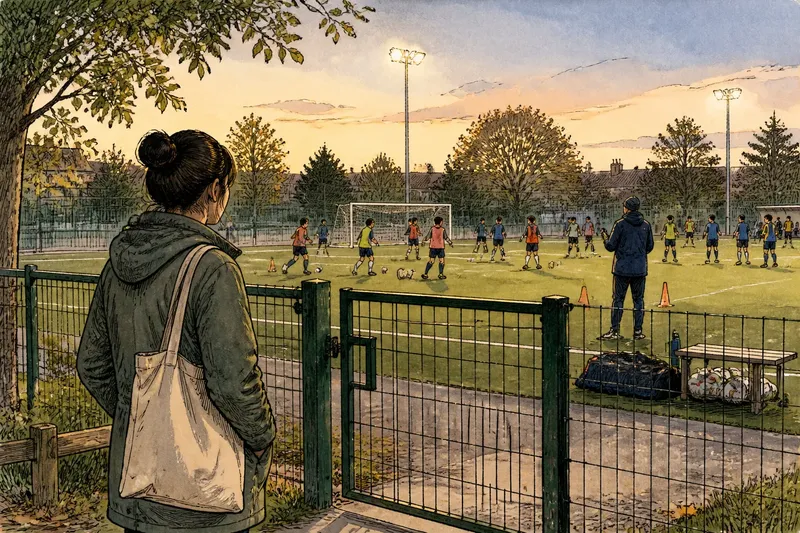
At the edge of a community soccer field, a visitor pauses beside the gate, unsure whether the open practice is meant for spectators or only for players. A first visit to an open practice can feel simpler if the aim is modest: watch without interrupting, learn the session’s shape, and leave when the moment feels right.
A first visit to an open practice begins with a quiet arrival
Imagine that Maya has been invited to observe a neighborhood club’s evening training. She knows one player casually but has never met the coach, and she does not intend to join in. Before leaving home, she checks the club’s public notice for the entrance, any spectator guidance, and whether the session is still open to visitors.
She arrives a little before the group begins, not early enough to crowd the players’ preparation. At the gate, she asks a volunteer, “Is there a place visitors usually stand?” That brief question is more useful than guessing from the touchline, where equipment bags, warm-up routes, or team instructions may make an apparently empty spot unsuitable.
If nobody is available to ask, Maya waits outside the active area and watches for the group’s movement before choosing a position. She keeps the entrance and the route between the field and benches clear. Her first task is not to find the best view; it is to avoid becoming another thing the session must work around.
Choose a position that stays outside the working space
Open practice does not always have a marked viewing area. A place behind a fence or along the outer edge of a field may be appropriate, while the sideline itself might serve as a coaching lane or a path for players moving between drills. The safest reading comes from watching how the space is already being used.
Maya notices that players repeatedly run toward one end to collect balls. She steps farther from that route and stands near a quiet section of fence, where she can see without blocking anyone’s line of travel. She keeps her bag close, leaves room for others, and avoids leaning over a boundary or crossing it for a better angle.
For a gym, court, or indoor training room, the same principle applies in a different form: stay out of doorways, equipment zones, and the edge where athletes need room to move. If the only available spot would put a visitor in the session’s path, waiting or choosing another day is a considerate option, not a failure to participate.
Watch the session’s rhythm rather than searching for a highlight
From her place by the fence, Maya first sees a short passing drill. Instead of tracking only the ball, she notices how players take turns, where they queue, and when the coach pauses the activity to explain a movement. Those small patterns reveal how the practice works without requiring her to interpret every instruction.
She also learns to distinguish a natural pause from an invitation to approach. A water break may still be a team moment, and players may use it to listen, reset, or speak privately. Maya watches without calling across the field or asking a player to explain a drill while the group is gathering.
In this invented situation, a second activity begins on the far half of the field. Maya shifts her view but not her position, so she does not cross behind the players or interrupt the coach. The observable result is straightforward: she can follow the change in activity while the group continues without adjusting around her.
Small choices help visitors keep the practice open
Being unobtrusive does not require elaborate rules. A few ordinary choices can protect the players’ concentration and the host club’s welcome:
- Keep phones silent, and avoid filming or photographing unless the club has clearly allowed it.
- Leave pathways, gates, benches, and equipment undisturbed.
- Watch from outside the active area rather than joining a drill uninvited.
- Save questions for a coach or host who appears available, rather than calling to players during an exercise.
- Keep comments supportive and low-voiced; do not coach, criticize, or call out tactical advice.
- Take litter and personal belongings with you when you leave.
Some visitors may want to take notes or sketch a formation. That can be fine if it does not turn into conspicuous recording or draw attention from the session. What is not worth the effort is trying to decode every coaching cue or follow every player at once; a calm, partial understanding is more useful than a strained attempt to catch everything.
What should a visitor know before arriving?
Do I need to ask permission before watching?
Check the club’s public information first, then ask a host or volunteer if the invitation or viewing area is unclear. An open session still belongs to the people training, so a courteous question is better than assuming every space is available.
Where should I stand if there is no spectator area?
Look for a place outside the players’ routes, coaching space, and equipment area. If no position leaves the group comfortable room, wait at the edge or return another time.
Can I take photos or video?
Do not assume that an open practice is open to recording. Follow the club’s posted guidance and ask the organizer before making images, especially when other participants may appear in them.
When is a good time to speak with someone?
A host or coach may be approachable before or after the session, or during a clearly relaxed interval. Keep the first exchange brief and accept a short answer as a sign that their attention needs to return to the group.
Leaving well is part of taking part
After the final drill, Maya waits until the players have begun packing up before she approaches the volunteer who greeted her. She thanks them and asks whether future sessions are open to visitors. The conversation stays short; she does not wait beside the team huddle or expect an introduction to every player.
She leaves by the same clear route she used on arrival, taking her bottle and making sure she has not left anything beside the fence. The visit has given her a feel for the club’s pace and layout, not a claim on anyone’s time. For a first visit to an open practice, that is enough: arrive with a question, watch from the margins, and let the people training remain at the center.