Why Courts Have Lines Within the Lines
Why courts have lines within the lines: see how layered markings organize shared space, where visual clutter begins, and which layouts suit a venue.
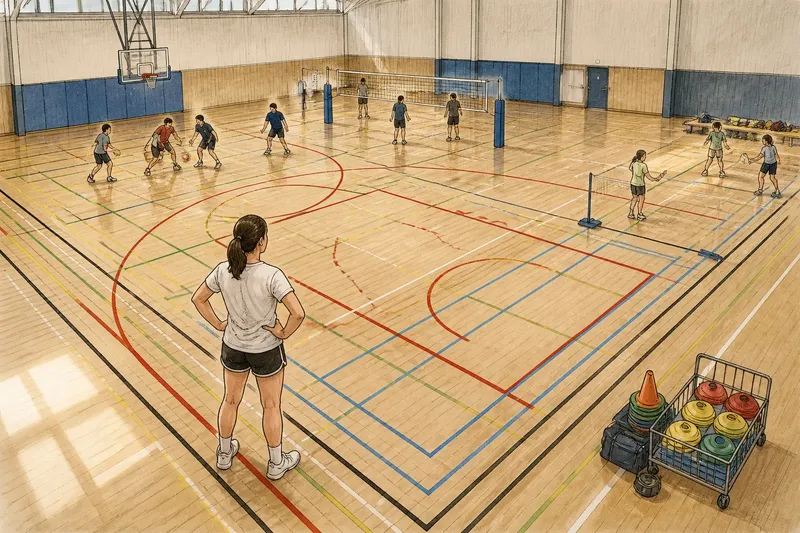
At a community gym, a player pauses at a tangle of painted arcs and rectangles before choosing where to stand. The outer boundary is easy to see; the finer court lines seem to argue among themselves. Those inner markings are not decoration: they divide the floor into useful visual zones, helping people recognize where a play begins, where bodies tend to gather, and which part of the surface belongs to a particular activity.
Why courts have lines within the lines is partly a question of geometry, but more often it is a question of shared attention. A single floor may serve different games, age groups, or practice formats. Markings let each use occupy a legible portion of the same space—if the colors, contrast, and placement help the eye sort them out.
Inner lines make space readable before play begins
A boundary tells players where the playable surface ends. Interior lines do a different job: they make distinctions inside that surface. A line can mark a zone for a particular action, separate areas with different roles, or give players a visible reference for positioning without a coach having to explain every location.
That visual information is useful even before someone knows all the rules. A newcomer can see that an arc, box, or semicircle marks a meaningful part of the floor and ask what it means. In a practice session, a coach can point to a shape and set a drill around it. The markings give people a common map, though the map still needs an explanation.
Lines also let a facility support more than one activity without permanently dividing the room. A school gym might combine basketball markings with volleyball or badminton layouts. Each set gives a different group a way to imagine the same floor, while the open surface remains available for equipment, warm-ups, or informal play.
Dedicated markings favor quick recognition
One approach is to give each activity its own strongly visible set of lines. This suits a venue where a particular game dominates, or where participants need to identify its boundaries quickly. The main layout can use a clear, high-contrast color, with secondary markings kept visually quieter.
The benefit is directness: players can locate the relevant shapes without first decoding a crowded floor. Coaches and officials can refer to familiar areas, and a visitor has a better chance of following where the action is meant to happen. Dedicated lines are especially helpful when the venue serves younger players or people who are still learning a game’s spatial logic.
The trade-off is that a floor designed around one activity may feel less accommodating to others. If several uses share the room, giving every one an equally forceful color can turn the surface into a visual contest. This approach fits best when the schedule and the people who use the space point clearly to one primary layout.
Color-coded layers accommodate shared floors
A second approach assigns separate colors to different activities. It suits multi-use gyms, recreation centers, and school spaces where the floor changes purpose across the day. In principle, a player can identify the right court by matching its color to the equipment, schedule, or coach’s instruction.
Color alone is not enough, however. Two shades that look distinct on a paint chart may become hard to tell apart under a gym’s lighting, from the bleachers, or against a worn floor. A color system works better when its sets differ in more than hue: line style, thickness, or the geometry of the markings can help distinguish one layout from another.
For example, imagine a neighborhood gym adding a badminton layout to a floor already used for basketball. The facility chooses a contrasting color for badminton and keeps the basketball lines visually dominant because that is the most frequent use. A player arriving for badminton can match the net and court shape to the secondary markings, while other users can still recognize the primary layout. The expected observable result is that both arrangements remain identifiable without treating every painted line as equally important.
Color-coded layers are a good fit when groups can learn a simple visual convention and the floor is large enough for the marks to remain distinct. They are less helpful when multiple layouts overlap heavily or when the people using the room have no reliable way to know which color applies that day.
Retractable or temporary boundaries preserve a quieter floor
A third option is to limit permanent markings and add temporary boundaries for activities that need them. Tape, movable floor markers, or portable court equipment can define a practice area without introducing another permanent line across the surface. This suits facilities that host varied activities, occasional events, or drills that do not follow a standard court layout.
Temporary marks are adaptable. A coach can make a smaller playing area for a group, set up stations, or create a route for a movement exercise. When the session changes, the floor can return to a less crowded appearance. That flexibility matters in rooms where the floor also serves assemblies, classes, or community events.
The compromise is that setup becomes part of using the space. Temporary boundaries must be visible, placed consistently, and removed or stored when they are no longer needed. They may not suit a busy venue that changes activities frequently and has little time or staff to reset the floor. Permanent markings are more readily available; temporary ones ask the user to create the layout each time.
Choose the layout by asking what users must notice
The best approach depends less on how many sports a venue can host than on how people identify the space they need. Consider the floor from the viewpoint of a player entering the room, a coach addressing a group, and someone watching from the side. If each person can pick out the relevant zone without a long explanation, the markings are doing useful work.
- Choose dedicated markings when one activity is the clear priority and quick recognition matters most.
- Choose color-coded layers when several regular activities share the floor and users can learn a consistent color convention.
- Choose temporary boundaries when layouts vary often, or when a less marked floor serves other purposes between sessions.
- Keep the visual hierarchy simple by making the most-used layout easiest to distinguish and avoiding several equally prominent line sets.
- Check the view from the room’s edges as well as from the playing surface, since a mark that is clear up close may disappear at a distance.
- Ask who uses the space and whether new participants can tell which lines matter before play starts.
Say a recreation center hosts a regular court sport, occasional youth clinics, and a weekly movement class. If the regular sport needs fixed boundaries, clinics can use a secondary color for their adapted zone, while the movement class can mark temporary stations with movable discs. The expected observable result is a floor that supports the familiar layout while allowing the less frequent activities to claim space without adding another permanent web of lines.
How do players read overlapping court lines?
Why do courts use more than one set of lines?
A shared floor can host activities that need different boundaries or zones. Each set lets users recognize a particular layout without requiring the facility to dedicate the entire room to one use.
Which court line color is easiest to see?
The clearest choice depends on the floor, lighting, viewing distance, and other markings already present. A venue should favor contrast that remains distinguishable across the room rather than choosing a color for appearance alone.
Can a multi-use court work without permanent lines?
It can, if users have practical ways to mark the layouts they need, such as portable markers or temporary tape. That arrangement suits flexible rooms, but adds setup and reset work to each session.
How can beginners tell which lines apply?
A consistent color or line-style convention helps, especially when equipment or a coach’s explanation reinforces it. A crowded floor with several similar-looking sets may require a simple orientation before play starts.
Visual clarity matters more than marking every possibility
Not every potential drill needs a permanent line, and not every available color needs its own court. It is usually not worth the effort to paint boundaries for a use that happens rarely if a few portable markers can serve it just as clearly. Extra markings can make a room seem more capable on paper while making it harder for people to see the layout they came to use.
When a venue considers changing its lines, it should first look at the floor during ordinary activity: which marks draw attention, which disappear, and where players hesitate. The answer to why courts have lines within the lines becomes practical at that point. A useful marking is not simply a rule drawn on the floor; it is a visual cue that helps people share the space with less guesswork.
For a court that serves several groups, the aim is not to eliminate overlap but to make the hierarchy legible. Choose one clear convention, explain it where newcomers enter, and reserve temporary markers for uses that do not need permanent boundaries. That leaves the floor ready for its next users without asking every line to speak at once.