The Match Programme or the Scorecard?
Match programme or scorecard: learn which printed companion suits a live event, from browsing team details to recording the contest as it unfolds.
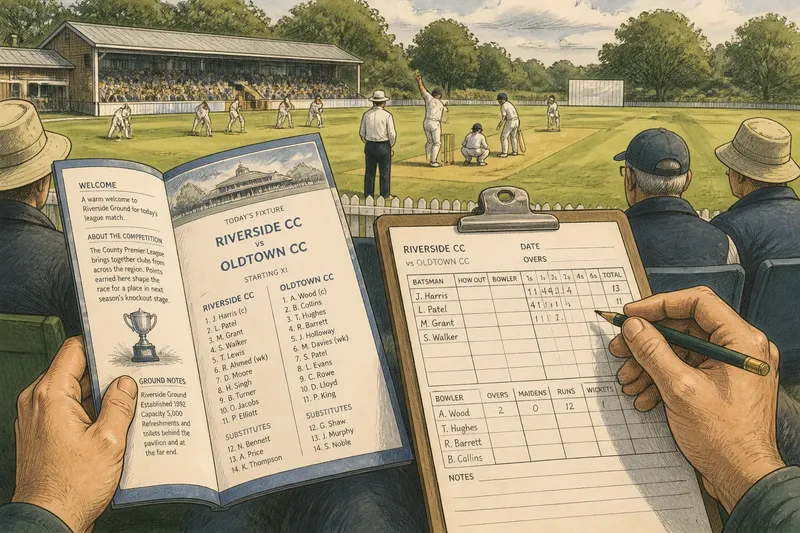
At a ground entrance, a folded programme can occupy the walk to your seat; at the boundary, a scorecard waits for the first delivery. The match programme or scorecard serves different kinds of attention: one helps you read the occasion, the other gives you a place to follow its changing record.
A programme gives the event its wider frame
A match programme is built for browsing. Its pages may introduce the teams, list participants, explain the running order, and include notes about the venue or competition. It helps a newcomer connect the names on the field with the people and customs around them.
That broader view is useful before play begins, during a pause, or when the action is hard to follow. A lineup can clarify who is starting; a short competition note can explain why a fixture matters. The programme’s main task is orientation, not keeping a live account of every turn.
At a local football ground, for instance, the programme might show the starting elevens and substitutes, while the scoreboard carries the score. You can glance from page to pitch and recognize a player without trying to write down every pass.
A scorecard gives the contest a working record
A scorecard is more closely tied to what happens next. It offers spaces, symbols, or columns for recording events as they occur, with the precise layout depending on the sport. In cricket, a card can track batters, bowlers, runs, and wickets; in golf, a card follows holes and strokes.
That act of recording changes the spectator’s rhythm. Instead of taking in the whole event at once, you attend to a sequence: who is involved, what happened, and where the record should go. A scorecard can make a long contest easier to follow, but it asks for attention that a programme does not.
Some cards are designed for formal scoring, while others are simplified for spectators. Before relying on one, look at its headings and symbols; if the rules or format are unfamiliar, ask an experienced scorer or consult the sport’s governing guidance. A neat-looking grid is not necessarily a complete scoring system.
Choose by the kind of attention you want
The useful choice is not which item is better, but what you want your hands and eyes to do. If you want context, names, and a sense of the day’s shape, choose the programme. If you want to follow a running sequence closely, choose the scorecard.
- For a first visit: start with the programme’s lineup and event notes, then watch without trying to record everything.
- For a sport with a changing tally: take a scorecard if you already understand the marks or are willing to learn them.
- For a companion who likes details: a card gives them a quiet task during pauses and transitions.
- For a relaxed day out: a programme is easier to dip into and put aside when play becomes absorbing.
- For a keepsake: consider which item will carry the memory you value: the occasion’s printed context or your own record of its course.
Say you attend a local cricket match and know the basic rules but not the players. You could use the programme to identify the teams before play, then mark each over on a simple spectator card; the expected result is a clearer sense of both who is involved and how the innings is progressing, without trying to reproduce an official scorebook.
Printed companions suit different moments
A programme is often most useful before the opening whistle or during a break, when there is room to read. A scorecard earns its place while play is active, especially in sports where the sequence of events matters to understanding the contest. You do not need to keep either item open all the time.
At a busy venue, wind, rain, and crowded seating can make loose paper awkward. A programme with a firm fold is easier to hold one-handed; a scorecard may need a clipboard or a hard-backed notebook beneath it. A pencil is generally more forgiving than ink if you expect to revise an entry, though the venue’s own scoring arrangements take priority.
It is not worth trying to write down every detail just because a grid is available. If recording makes you miss the play, leave some spaces blank and return your attention to the field. The card is a companion to watching, not a substitute for it.
Questions about programmes and scorecards?
Can a programme include a scorecard?
Yes. Some programmes include a small fixture or scoring section, but it may be intended for a light record rather than detailed scoring. Check whether its fields match the sport and the level of detail you want to follow.
Is a scorecard useful if I am new to the sport?
It can be, provided you treat it as a guide rather than a test. Start by following the visible headings and ask someone nearby what an unfamiliar mark means; you can also watch first and begin recording once the pattern makes sense.
Should I buy a printed copy or use a phone?
Printed copies are easy to annotate and do not require you to switch between an event and a screen. A phone may offer current lineups or a digital scoring tool, but its usefulness depends on venue rules, signal, and your preference for keeping the event in view.
Which one makes the better souvenir?
A programme preserves the event’s framing, such as the fixture and printed lineup; a marked scorecard preserves the course you followed. If you keep paper, add a brief note about the match or the people you attended with, so the object can call back more than the final result.
Let the paper match the memory
When deciding between a match programme or scorecard, think about what you would like to remember: the cast and setting, or the unfolding sequence. The distinction is small but useful. One helps you enter the occasion; the other lets you keep pace with it.
If the event offers both, there is no need to choose before you arrive. Read the programme while finding your bearings, then take a scorecard only if following the record adds to your enjoyment. A few handwritten marks beside a printed lineup can be enough to turn a fleeting afternoon into a memory with its own texture.