From Club Badge to Shared Emblem
A club emblem becomes a shared emblem when its design carries local memory clearly. Learn what to preserve, simplify, and invite others to interpret.
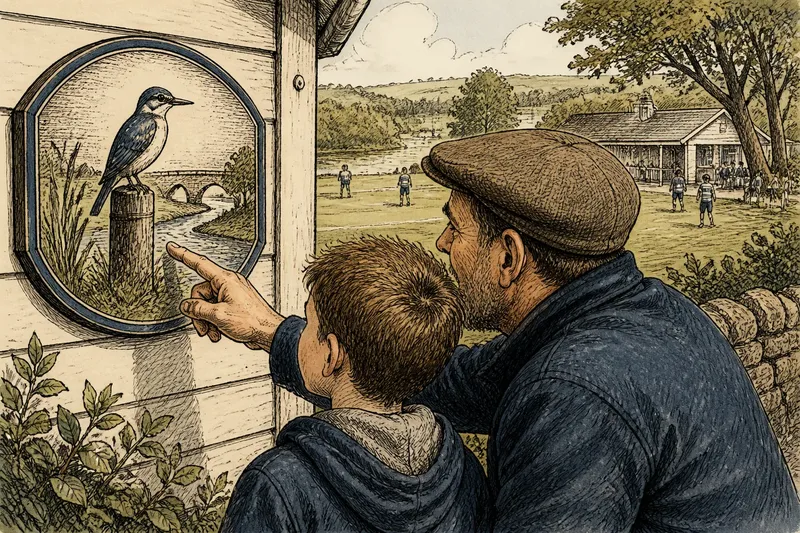
At the community field, someone points to the small bird on a clubhouse sign and tells a child why it faces the river. That detail has outlasted several paint jobs, and people who have never worn the club’s colors still recognize it. A club emblem can become a shared emblem when its design gives a group a place to gather its memories—not merely a mark to identify its team.
The change is not automatic, and it cannot be ordered into existence. It grows through repeated use, stories, and recognition across different kinds of participation. If a club is considering how its emblem should develop, the useful question is not simply whether the design looks modern. It is what kind of relationship the mark already has with the people around it, and what the next decision should protect.
Club emblem design begins with the people who recognize it
Before discussing colors or shapes, distinguish between recognition and belonging. A supporter may identify a shield on a noticeboard without feeling any connection to it. Someone else may feel represented by a familiar local symbol even if it appears only on a clubhouse wall. An emblem becomes shared when different people can find meaning in it without needing identical roles or histories.
That distinction helps a club choose its next move. A mark that mainly serves as a clear identifier may need better legibility and consistent use. A mark already surrounded by local stories may need careful stewardship rather than a redesign. In either case, the emblem’s meaning is carried by its setting: the grounds, neighborhood, club routines, and conversations that make its symbols understandable.
Begin with a modest inventory. Ask longtime members what they notice first, invite newer participants to describe what they can identify, and ask people who live nearby what the emblem brings to mind. These are not votes on whether someone is entitled to belong. They are ways to hear where the mark is already legible, where its meaning is private, and which details deserve a closer look.
Choose a design response that fits the emblem’s current role
The same design choice can help one club and unsettle another. A detailed crest may hold several generations of reference, while a simple silhouette may be the only feature people recognize from across a shared space. Sort the decision by situation rather than treating redesign as the default.
If people recognize the symbol but not its story
Keep the recognizable form and make its meaning easier to encounter. A short explanation beside the emblem, a conversation during a club gathering, or a page in a local history display can connect a shape to its place without turning the design into a crowded illustration. This suits clubs whose mark is visually familiar but whose origin has become difficult to explain.
Be precise about what is known. If a bird, bridge, hill, or tool was chosen for a clear local reason, describe that reason plainly. If its origin is uncertain, say that the story has several versions rather than presenting one as settled fact. Openness makes room for memory without asking an attractive guess to stand in for evidence.
If the emblem is difficult to read at a glance
Look for a simple, recognizable feature that can carry the design across different sizes and settings. It might be a distinct outline, a single strong shape, or a compact arrangement of initials and a local symbol. Preserve enough of the existing character that people can still see a connection, while reducing details that vanish in small reproductions.
This situation calls for clarity, not for stripping away every reference. A simplified drawing can retain a familiar river bend or old gate if that feature is what people remember. What is not worth the effort is polishing tiny decorative marks that disappear at a distance and have no shared meaning outside the design file.
If people dispute what the symbols mean
Separate the visual decision from the historical question. Record the interpretations people offer, note which details are supported by club records or local accounts, and identify what remains uncertain. If the disagreement is about who the emblem includes, listen for the experiences behind that concern before asking anyone to defend a preferred shape.
A redesign can make a dispute more visible without resolving it. In this situation, a listening process and a clear account of what the club knows may be more useful than a quick choice between competing sketches. The design can be revisited once the club understands whether the disagreement concerns legibility, historical accuracy, or belonging.
If newcomers cannot see themselves in the emblem
Ask what feels absent, and whether the problem sits in the drawing, its explanation, or the way the club presents itself. A mark cannot represent every individual experience, but it can avoid treating one generation’s memory as the whole club’s identity. A fresh symbol may help, or a more generous interpretation of an existing one may do the job better.
For example, imagine a neighborhood club whose old crest shows a gate that new families associate only with an entrance they have never used. Members could ask what the gate means to them, then compare that account with newer residents’ descriptions of the place. If the shared ground is a riverside path rather than the gate, the expected result of that conversation might be a clearer explanation, a modest design revision, or a decision to preserve the crest while adding a second, locally recognized motif.
Use the emblem’s history without turning memory into a test
Shared identity depends on invitation, not on passing an informal exam in club lore. Longstanding members may know why a particular line curves or why a local tree appears in the mark. New participants may bring their own associations from the neighborhood, a school, or a family tradition. Neither form of knowledge should automatically cancel the other.
When collecting stories, ask open questions: What do you notice? What does this remind you of? Is there a detail you would miss if it disappeared? These prompts make room for affection and uncertainty, rather than pushing people toward a single official answer. Keep notes on recurring themes, but do not mistake a repeated opinion for proof of a symbol’s origin.
A club can also distinguish between the emblem’s history and the meaning people give it now. An older feature may have been selected for a practical reason, then become associated with a neighborhood gathering place. The present meaning is real even when it differs from the original intention. Saying so allows the emblem to remain alive rather than freezing it at the moment of its creation.
Let the emblem speak across generations and roles
A shared emblem should be encountered beyond the people who compete. It may appear on a clubhouse notice, a community event flyer, a wall near the grounds, or a small local archive display. Each setting gives the mark a different audience, and each can help people connect the symbol to a place and a group rather than to a single match-day function.
Consistency matters, but it does not require every use to carry a full origin story. A clear master design can be accompanied by a short description that explains the symbol in ordinary language. Where space is limited, the mark itself should remain recognizable; where people have time to look, a fuller account can describe the club’s relationship to its surroundings.
Pay attention to who gets to tell that account. If only one committee member can explain the emblem, the meaning may feel guarded even when the design is public. Invite several people to contribute descriptions in their own words, then make the club’s agreed account easy to find. The point is not to produce a single script for every conversation, but to keep useful context from becoming private property.
Questions to settle before changing a club emblem?
Should a club preserve an old emblem even when its meaning is unclear?
Preserve it if people recognize it and the uncertainty can be explained honestly. A club can keep the design while documenting what is known, what is remembered, and what remains unresolved.
How can a club make an emblem feel more inclusive?
Ask different participants and neighbors what they understand the mark to represent, then respond to specific concerns rather than relying on a general claim that everyone is welcome. Sometimes the needed change is in the design; sometimes it is in the story told alongside it.
Does a shared emblem need to be redesigned?
No. If the existing mark is legible, meaningful, and recognized across the club, better interpretation or broader use may be enough. Redesign makes sense when the current form prevents recognition or carries a meaning the club has reason to address.
Who should decide what the emblem means?
People responsible for the club’s decisions should create room for those affected by the emblem to contribute. The club can explain how it weighed those views and distinguish community interpretation from claims about documented history.
Make a change only when it gives people a clearer way in
Before approving artwork, compare how the existing emblem and proposed version read at a glance, what story each can carry, and who might feel addressed or left outside. Ask a designer to show a plain, small-scale rendering as well as a detailed version; the useful question is whether the essential symbol survives without its decoration. Check any established club records or relevant local guidance before presenting a historical claim as fact.
Then explain the decision in a way that leaves room for continued conversation. A club might keep an old outline, redraw one confusing feature, and publish a short account of why that choice was made. Another might decide not to change the image yet, because members have not agreed on what its symbols mean. Either choice can be thoughtful if people understand the reason and know how to add their perspective.
A club emblem becomes a shared emblem through use that people can recognize and interpret, not through a single unveiling. The best next decision depends on the club’s actual situation: clarify a story, improve legibility, address a dispute, or make room for newcomers’ associations. When people can point to the mark and explain, in their own words, how it connects them to a place and one another, the design has begun to do more than identify the club.